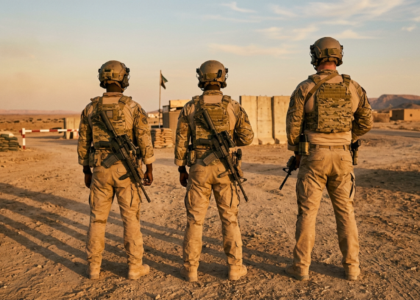

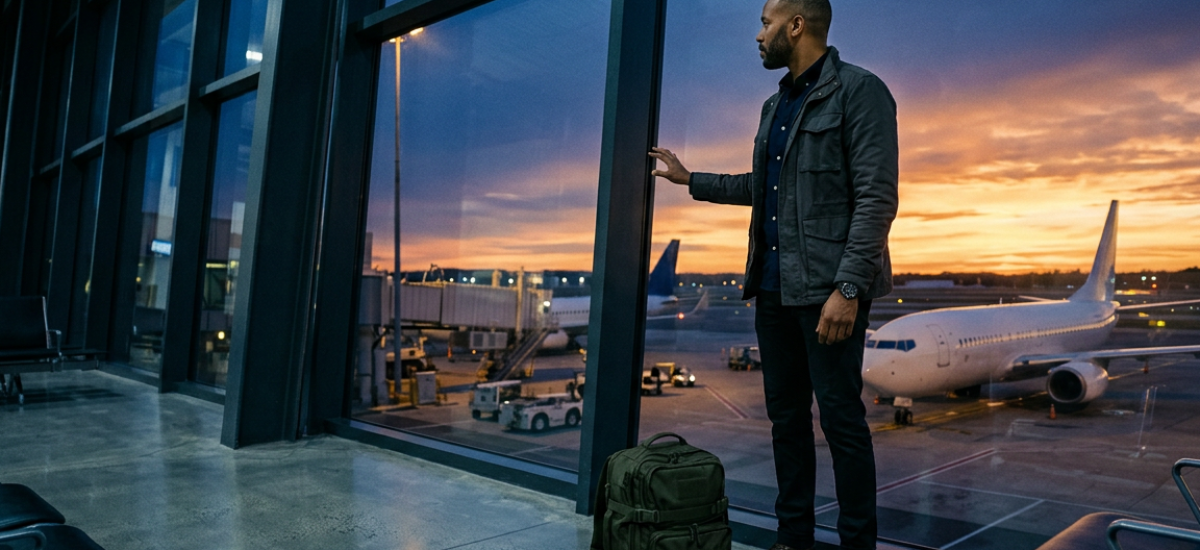
Getting to the job is its own operation. Air travel, connections, luggage, people you meet, things you carry, how you carry your money, how you are received on arrival — and the decisions you make on that first night that can end a career, a marriage, or a life. Nobody briefs you on this. We will.
Pre-Departure: What Goes In The Bag And What Stays Home
Your luggage is your first operational profile. Security contractors travelling on commercial flights through sensitive hubs — Dubai, Doha, Addis Ababa, Nairobi — are flagged by both corporate security systems and government intelligence actors. What you carry communicates who you are before you say a word.
- What to carry: Copies of your contract and employment letter in both physical and encrypted digital form. Two forms of ID — passport plus one backup. A basic personal first aid kit. Prescription medication in original pharmacy packaging with a doctor’s letter. Neutral, business-casual clothing for transit — not tactical gear, not branded military-adjacent clothing.
- What never travels in checked luggage: Any document containing classified project names, client identities, or site locations. Loose ammunition, even inert training rounds — they will end your trip. Personal laptops with unencrypted operational data.
- What does not travel at all: KDF service documents, military identification beyond what your contract requires, anything that identifies you as a security contractor in countries that restrict private military activity.
Cash Versus Cards: Why Experienced Contractors Fly With Cash
This is one of the most practical pieces of advice a veteran ever receives, and almost nobody follows it until they have learned the hard way. When you land in Nairobi after a 90-day rotation with USD in your pocket, the temptation is to shop at duty-free, pick up gifts, buy electronics. The problem is that any significant purchase triggers customs scrutiny on the way out, and on your next departure, you may be frisked, questioned, and delayed because you are now flagged as someone who moves goods and cash through the airport.
Experienced contractors keep a disciplined travel financial protocol: carry USD $200–500 in cash for emergencies, transit meals, tips, and unexpected costs. Use a debit card tied to a dollar-denominated account for larger expenses in destination countries. Do not carry large amounts of local currency across borders. Do not flash wealth at airports in either direction — arriving or departing. The airport is an intelligence environment, not a shopping mall.
I watched a colleague get detained for hours at the airport because she chose not to declare to be traveling with a large amount of cash and could not explain where the $31,000 USD came from. She missed her connection, missed her deployment window, and almost lost the contract.” — Security Contractor, 8 years field experience
Connection Flights: The Hours Nobody Accounts For
A layover in Dubai, Doha, or Istanbul can be 4 hours or 14 hours. Most contractors do not plan for this time and it becomes a zone of poor decisions — overspending, over-drinking in airport bars, or accepting invitations from strangers who are far too interested in where you are going and why. Long layovers are not down time. They are an operational exposure window.
- Book a day room or transit hotel for layovers over 8 hours — sleep is a tactical advantage, alcohol in a terminal is not
- Avoid detailed conversations about your employer, destination, or role with anyone you meet during transit — this includes other contractors who seem to share your world
- Keep your travel documents on your person at all times in transit — not in your carry-on bag, not in your jacket left on the seat
- If you are on a premium-tier airline ticket or upgrade, the lounge is genuinely worth it — quieter, safer, and the networking with business and diplomatic travellers can open doors that no recruiter ever will
Seat Upgrades: The Overlooked Networking Tool
This is advice that sounds like luxury but is actually strategy. Many veteran contractors dismiss business class as an indulgence they cannot afford. Reconsider. The people seated in business class on routes between Nairobi, Dubai, Doha, and Addis Ababa include: diplomats, NGO directors, corporate security managers, UN mission chiefs, and senior government officials. One genuine conversation on a 6-hour flight has produced more career-changing opportunities for contractors than months of online job applications.
When a bid-up upgrade is offered at check-in for $80–$150, treat it as a networking investment, not a comfort purchase. Dress accordingly before you board. Carry business cards. Be curious rather than eager. Ask questions. Listen more than you speak. You are not selling yourself — you are becoming someone worth remembering.
Airport Pickup Versus Travelling Alone: Risk Assessment
When you land in an unfamiliar country, the question of who meets you matters significantly. An employer or verified team member picking you up at the airport is the safest option. If you are travelling alone to meet a team in country, establish a clear communication protocol before departure: who calls whom, what the fallback is if there is no answer, and where the nearest embassy is located.
- Never accept a pickup from someone you cannot independently verify — confirm driver identity and vehicle registration details in advance
- In high-risk cities, never display luggage bearing your employer’s name or branding in public transit zones
- If travelling alone, check in with a designated contact at home upon landing and at your first secured location
- Have the local emergency numbers and your country’s embassy contact saved offline before you land — not on an app that requires data
The First Night Risk: What The Deployment Brief Will Never Cover
This section is written plainly because the alternative is that men continue to make avoidable, life-altering decisions in silence. The first night of arrival — especially after a long haul, in a new city, with money in your account and adrenaline still running — is statistically one of the highest-risk nights a contractor experiences. Not from enemy action. From choices.
The pattern is predictable: exhaustion plus excitement plus alcohol plus availability equals decisions that a rested, clear-headed man would never make. Airbnb arrangements in some deployment cities come with social offers that feel casual and low-stakes. They are not. The risks are direct and compounding: HIV and STI exposure in regions with significantly higher prevalence than Kenya, potential blackmail or intelligence compromise if you are seen as a target, financial theft, and — most destructively — the erosion of the family and marriage that is the entire reason you took the contract in the first place.
Your wife and children waited for you through 90 days of silence, uncertainty, and absence. The first night decision is not just a personal one — it carries the weight of everything they carried while you were away. Go home. Or if home is far, go to your room. The other option is never worth what it costs.
HIV infection rates in several contractor operating regions — including parts of East Africa, West Africa, and some Middle Eastern transit cities — are significantly above Kenyan averages among certain populations. A single high-risk encounter carries real statistical exposure. An HIV diagnosis does not just affect your health — it affects your medical clearance, your employment, and your family. This is not moralising. It is operational risk management applied to your own body.
The Travel Mindset: Soldier Discipline In Civilian Clothes
The skills that made you effective in uniform — situational awareness, pattern recognition, controlled behaviour under pressure, mission focus — are the same skills that make you a safe and effective traveller. Apply them. Every airport is an operational environment. Every transit city is an area of operation. Every stranger who approaches you with too much friendliness is an unknown contact until proven otherwise. Stay switched on. The deployment has not started yet, but the mission has.